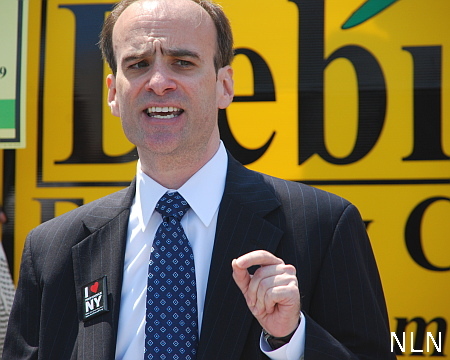
Jonathan Tasini
(Photo: Thomas Good / NLN)
STATEN ISLAND, N.Y. — Former union president Jonathan Tasini is running for the U.S. Senate and he feels that his opponent, Kirsten Gillibrand, has an image problem — the “gun lady” was appointed by an unpopular governor, has strong ties to big tobacco, and is anti-immigrant.
In 2006 Tasini challenged Hillary Clinton in a Democratic Party primary. He is running again — this time against incumbent Senator Kirsten Gillibrand. Gillibrand was appointed by Governor David Paterson to fill the vacancy created when Clinton become U.S. Secretary of State. Gillibrand is a conservative Democrat — a member of the Blue Dog Coalition — and, Tasini feels, out of touch with voters in the downstate area.

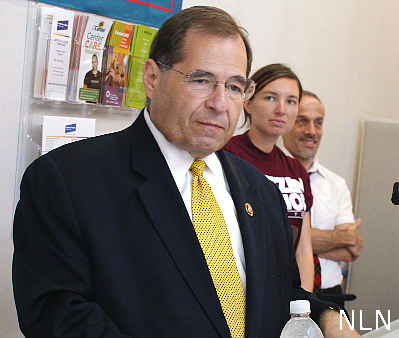
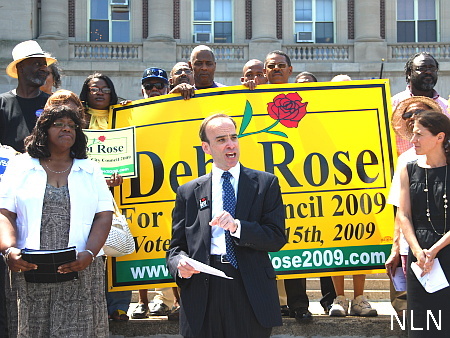
Tasini with antiwar activist Elaine Brower
(Photo: Thomas Good / NLN)
On Saturday, August 22, Jonathan Tasini spoke at a campaign fundraiser hosted by antiwar activist Elaine Brower.
Although Tasini has been an antiwar activist for some time — he opposed the 1991 Gulf War — he sees himself primarily as a labor organizer. Tasini was president of the National Writers Union, Local 1981 of the UAW, from 1990 to 2003. During his 13-year reign, NWU membership increased from 2300 to 7000 members.
“I was very very proud of what we did but in general, not just in the union, in my union — my passion, my commitment has been on a daily basis, to build a labor movement that isn’t just the structure of a union but a movement that protects workers and stands up for people, makes sure that we get the benefits of the hard work that we put into this country. And, as I mentioned sort of in a side conversation, I don’t think that’s happened in the last thirty years.”
Tasini feels that the plight of freelance writers — the workers represented by the NWU — is shared by workers everywhere: no healthcare, wages that don’t keep up with inflation, inadequate or nonexistent pensions and lack of job security.

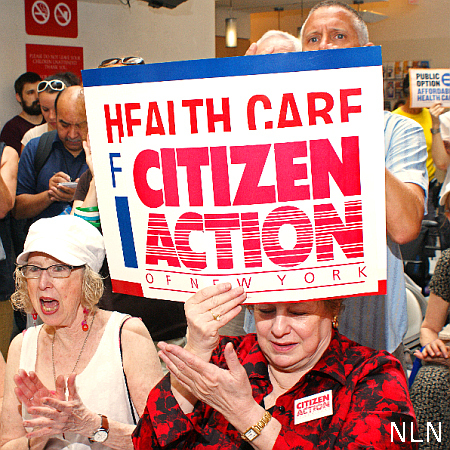
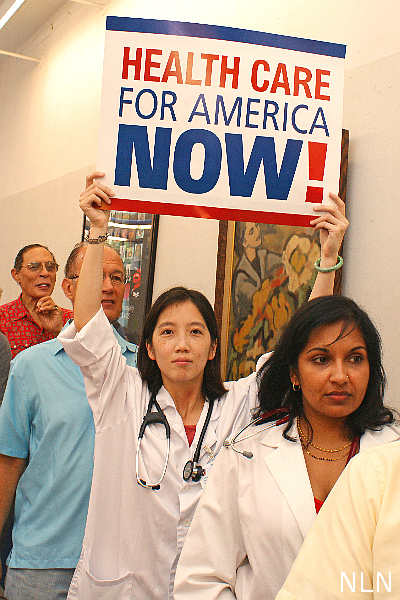
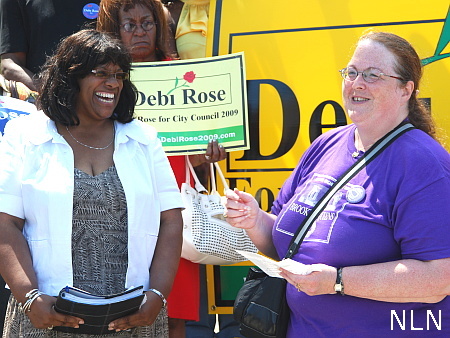
Tasini feels health care costs crippled the auto industry
(Photo: Thomas Good / NLN)
“48 million Americans don’t have healtchare in this country. And tens of millions more have to pay outrageous prices for healthcare coverage and get inadequate healthcare. To me that is entirely immoral and that has got to stop,” Tasini said.
Tasini feels that the cost of inadequate health care has wide-ranging repercussions — and is to blame for many of the problems confronting the United Auto Workers, the parent union of the NWU.
“It is all about health care costs. If we had a single payer system, medicare for all, ten years ago, the auto industry would not have tens of billions of dollars in costs. So when I’m elected as a United States senator I’m not going to be fighting to protect the private insurance industry, the pharmaceutical industry, they’ve got enough of a caucus, they have enough people protecting them,” he said.
Tasini’s campaign is about “drawing the line”, he said. Tasini, who advocates single payer health care, a “universal pension system” (partnership between government and individuals) and an end to the Afghan War, argues that now is the moment to take on the special interests that he feels are profiting at the expense of the average worker.

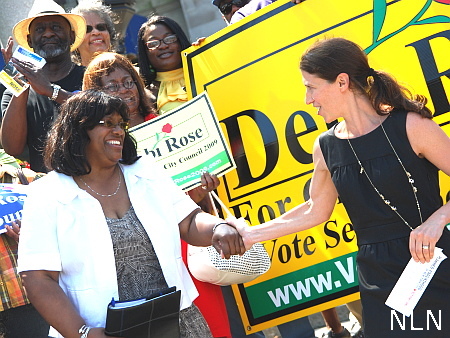
Tasini speaking to a group of supporters
(Photo: Thomas Good / NLN)
“We’re not going to, anymore, allow the powerful interests to prevent us from having decent health care, from having a decent job, from having a decent pension,” he said.
Tasini, who lived through the Vietnam War, watching the weekly body count as a child, is opposed to the Afghan War. Initially enthusiastic about allegedly high body counts (of dead Vietnamese Army regulars and National Liberation Front ‘Viet Cong’), Tasini learned from his father that “People just want their independence, and … it has never been true in history that a foreign conqueror can suppress people.”
Noting that this lesson is “Embedded deep in my consciousness”, Tasini said that “There is no such thing as a good war in Afghanistan.”
But can he win? Tasini feels he can, noting that this campaign is very different from his 2006 challenge to Hillary Clinton:
“We can win this campaign, I’m absolutely sure of that. In 2006, as Elaine mentioned, I ran against Hillary Clinton. I knew every single day that I woke up that I was not going to win that race. Because, it was just impossible, it’s very difficult to run essentially against a superstar.”
What’s different now? According to Tasini, Gillibrand has an image problem that even her corporate backers’ cash will have trouble erasing.
Gillibrand is “Deeply, deeply unpopular, primarily in what I would consider the downstate area, five boroughs and Long Island. And mainly because of her positions that she has taken in the past. She supports the National Rifle Association, in my opinion, one of the most extreme organizations in the country. (She) was very anti-immigrant. When I campaigned in 2006, I would campaign in that district and I was apalled at seeing the fliers that were being circulated by her campaign,” Tasini said.
“The test of who you are as a politician, as a candidate, as a human being, is how you relate to people who are the most vulnerable and the people who have the least defense. And immigrants, undocumented workers, are some of the most vulnerable people in our society,” he added.
According to Tasini, Gillibrand “Was very, very aggressively pro-tobacco industry, both as a lawyer — and then took tons of money from the tobacco industry.”
It’s much harder to undo a negative image than to reach people who don’t know who you are, Tasini argues. When he and his staff go into the streets to talk to voters they often ask people what they think of Gillibrand.
“Most people, this fogs comes over them, or they say, ‘oh yeah she’s the gun lady’ — that’s not a good place to be in a Democratic primary,” Tasini said.

Tasini organizer “Jan” — a former Obama campaign worker
(Photo: Thomas Good / NLN)
Acknowledging that it will take more than Gillibrand’s image problems to push his campaign over the top in the polls, Tasini remains optimistic, seeing “three circles” of much needed support: the network of supporters he built in his previous campaign, the Obama effect — a surge in grassroots activism and organizing that can successfully challenge corporate-backed politicians, and the support of organized labor. When Tasini challenged Clinton, labor declined to support what it regarded as a symbolic effort. But, according to Tasini, Gillibrand is vulnerable and organized labor is now willing to back him in his bid to unseat the incumbent.
The fact remains, however, that Gillibrand will easily outspend Tasini as the pockets of her corporate sponsors are deep and Tasini is running a grassroots campaign. For this reason he is engaged in a vigorous fundraising effort and urges progressives to support him financially as well as politically.
“Certainly money is the most important thing,” he said.
View Photos/Videos From The Event…