Then shall he say also to them on the left hand, ‘Depart from me, you cursed, into everlasting fire, prepared for the devil and his angels: For I was an hungered, and you gave me no meat: I was thirsty, and you gave me no drink: I was a stranger, and you took me not in: naked, and you clothed me not: sick, and in prison, and you visited me not.’ Then shall they also answer him, saying, ‘Lord, when saw we you an hungered, or thirsty, or a stranger, or naked, or sick, or in prison, and did not minister to you?’ Then shall he answer them, saying, ‘Truly I say to you, Inasmuch as you did it not to one of the least of these, you did it not to me.’
— Matthew 25:31-45

City Council Member Debi Rose with
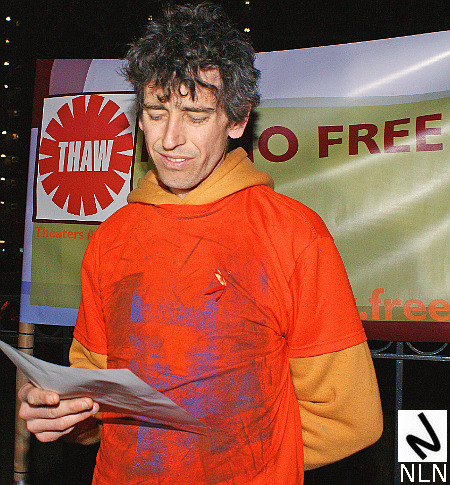
Mental Health Council Co-Chair Larry Hochwald
(Photo: Thomas Good / NLN)
STATEN ISLAND, N.Y. — The vast majority of the mentally ill are not now — nor have they ever been — criminals. But they are the least among us, seen as stereotypes, blamed for their illness. And the stigma attached to having a serious mental illness makes it very difficult to attain the two things that are most effective in facilitating recovery: housing and jobs.
According to the Mental Health Council’s Co-Chair Larry Hochwald, “What we need are good places to live — and jobs. That’s what everybody needs and it’s no different for us.”
While there is a lower class I am in it; while there is a criminal element I am of it; while there is a soul in prison, I am not free.
— Eugene Debs
Hochwald offered his remarks at the Staten Island Mental Health Council’s annual Legislative Breakfast, held on Friday, March 19 at the Staaten catering hall. The event was well attended by providers and consumers of mental health services, elected officials and members of Staten Island’s progressive community.

Reverend Terry Trois, director of the Project Hospitality homeless shelter
with Mental Health Council Co-Chair Larry Hochwald
(Photo: Thomas Good / NLN)
The crowd listened attentively as Assembly Member Michael Cusick, long a friend of caregivers, warned of cuts to the budget.
“Right now, these next seven days, up in Albany, next week, is going to be crunch time,” said Cusick. “The budget is due at the end of April.”
“I’m not going to sugar coat it, there are going to be cuts,” he added.
Cusick’s warning of a “devastating” budget was echoed by Janele Hyer-Spencer whose “dismal” prediction was followed by a promise that “Your needs and desires are not lost on us.”
Hyer-Spencer also spoke about the controversy surrounding the Office of the Medicaid Inspector General. Critics allege that OMIG has used audits as a revenue stream — negotiating settlements on questionable deficiencies — rather than as a legitimate enforcement tool. The Mental Health Council has asked elected officials to force OMIG to focus it audits on legitimate problems: fraud, abuse, neglect and overpayments. Hyer-Spencer agrees with the recommendation.

Assembly Member Janele Hyer-Spencer
(Photo: Thomas Good / NLN)
“We recognize, through ourselves, our colleagues in government, that the intent of the office of the inspector general has probably gone astray, and gone astray in a negative and disingenuous direction,” she said.
Matt Titone, who currently has a bill before the Assembly that would provide separate facilities for children and adults receiving care (A05903), addressed the issue of Staten Island’s precarious situation — one of the three hospital systems providing mental health care services is teetering on the brink of insolvency.

Assembly Member Matthew Titone
(Photo: Thomas Good / NLN)
“Saint Vincent’s has a huge footprint on Staten Island. Anything that happens to that hospital in Manhattan will affect what happens on Staten Island.”
Titone promised to advocate for keeping the hospital — and the jobs — on Staten Island.
Several health care consumers spoke about how independent living and employment has changed their lives and urged the crowd to fight the budget cuts and continue the struggle to educate the general public about the special plight of the mentally ill — who face prejudice in addition to suffering a devastating illness.

The Mental Health Council’s Larry Hochwald
(Photo: Thomas Good / NLN)
Larry Hochwald echoed these sentiments, telling the crowd that he has read a number of newspaper articles that perpetuate stigma by offering only the perspectives of residents of neighborhoods slated for new housing projects — residents who are uninformed and anxious and who often see the mentally ill as stereotypes.
“Nobody comes to the Staten Island Mental Health Council,” Hochwald said of local reporters, “nobody ever asks us for information.”
“When I read articles they always have somebody quoted who is not actually a member of the Staten Island Mental Health Council. It doesn’t surprise me that they find people who says things that go along with the gist of the article, or the gist of the thought. That pretty much makes their case,” Hochwald said, referring principally to Staten Island’s only major newspaper, The Advance.
Many of the comments posted in the apparently unmoderated silive.com reader’s forum, called “saliva dot com” by progressives who bemoan the lack of moderation, are hateful by any reasonable measure. Other comments clearly indicate a lack of fundamental knowledge and parental anxieties that should be addressed.
Hochwald said that many of the comments are about the fear parents have of new housing projects opening near public schools or other areas where neighborhood children gather.
Hochwald summarized the comments: “‘We’re afraid for our kids to walk past that building…'”
Hochwald argued that crime statistics suggest parents have far less to fear from housing projects for the mentally ill than from their neighbors. Hochwald drew applause when he said, “The reality is you need to be afraid when you walk past all those houses with the shades drawn down. Last time I checked, nobody in this room got to pick their neighbors — nobody in here got to pick who buys the house next door or who rents the apartment next door.”
Striking a conciliatory tone, Hochwald said that the issue is stigma and that everyone, including providers of mental health care, is subject to it. The cure is education.
“We don’t need to fight about it, we need to educate people,” Hochwald said.
New York City Department of Health and Mental Hygiene Assistant Commissioner Trish Marsik agreed.

Trish Marsik, Assistant Commissioner for NYC’s DOHMH
(Photo: Thomas Good / NLN)
“People with mental illness are us. They’re our families, they’re our coworkers and we have to figure out ways of telling our neighbors about what that means for folks. People with mental illness are far more likely to be victims of a crime than to be perpetrators. That people with mental illness die decades earlier than other individuals. And remind people that Staten Island is a community that rallies around people in need. The big, shining example is 9-11,” Marsik said.
Marsik said that “Supported housing [ projects ] is a proven way to show the support for people who really need services.”
Marsik’s boss, DOHMH Executive Deputy Commissioner Dr. Adam Karpati, tied it all together.

Dr. Adam Karpati
(Photo: Thomas Good / NLN)
“It’s actually quite refreshing to be among people who really understand the complementary nature of things like clinics and services and medical services with things like employment and housing — and how health and mental health cannot really be achieved without thinking broadly about the needs, the global needs, of people.”
View Photos/Videos From The Event…