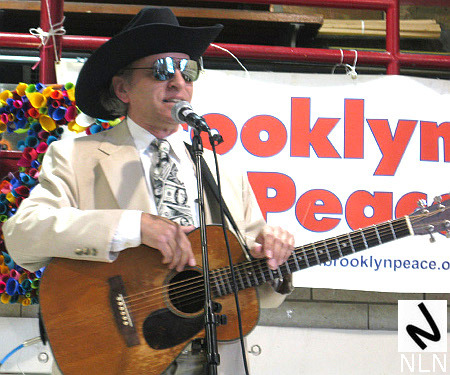
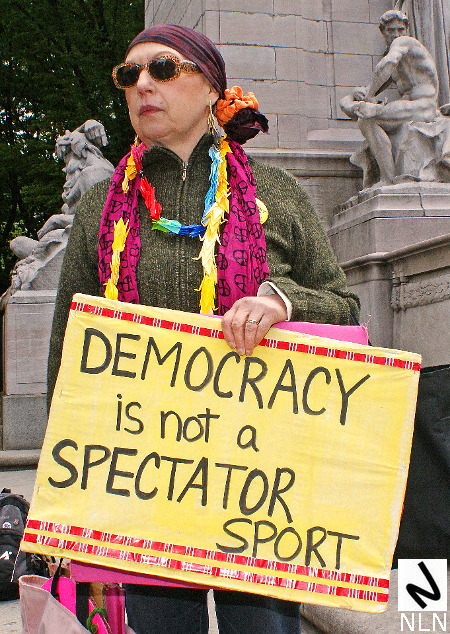
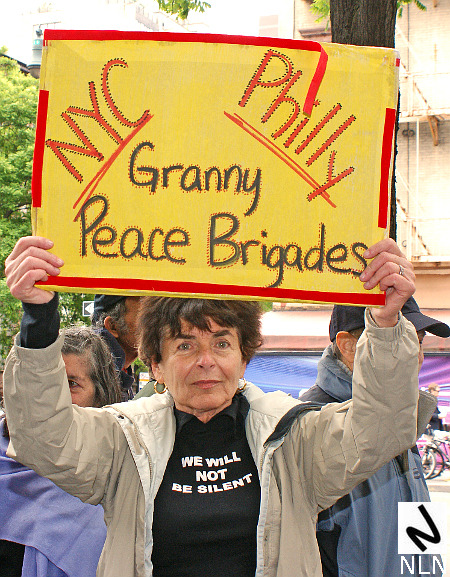
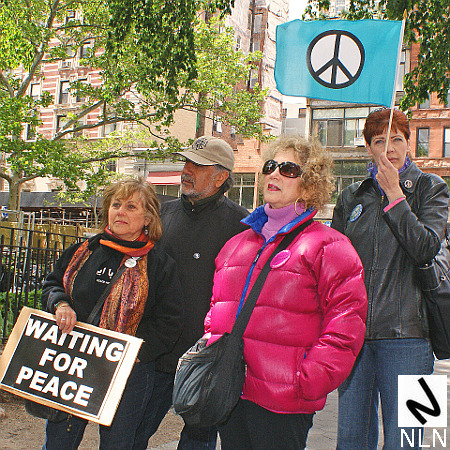
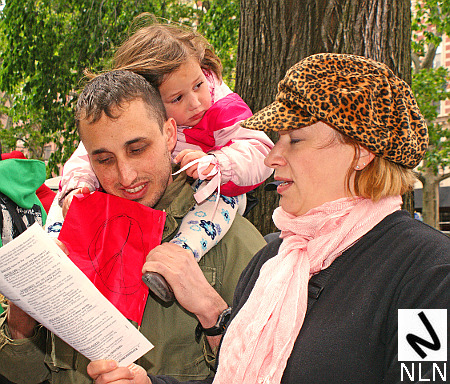
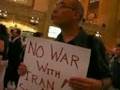
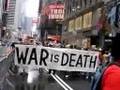
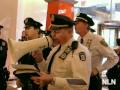
Vigilers gathered outside the Metropolitan Correctional Center
(Photo: Bud Korotzer / NLN)
NEW YORK — May 3, 2010. Syed “Fahad” Hashmi’s case was due to go to trial on April 28. Two days before prosecutors requested an anonymous jury citing as a reason that jurors might be frightened by Fahad as well as by his supporters who may fill the courtroom and share his radical Islamic views. An anonymous jury is escorted into and out of court by armed US Marshals, is sequestered, and their identity is hidden. They are made to feel that their lives are in danger. Judge Preska granted their request and in doing so, in effect, she criminalized the defendant and his supporters.
The very next day, despite implying that the jurors faced mortal danger from Fahad and the civil libertarians supporting him, the government made the offer of a plea-bargain. If he would plead guilty one count of conspiracy for allowing an acquaintance to store waterproof socks and ponchos in his apartment the other charges would be dropped and 55 years would be shaved off his sentence. Counting time already served and possible time off for good behavior he could be out of prison in eight-and-a-half years. After three years in solitary confinement, facing a frightened anonymous jury, with secret evidence and no presumption of innocence, Fahad felt there was little chance of a fair trial and he took the deal offered.
On Monday, May 3, the 19th and last vigil for Fahad Hashmi took place in the usual place opposite the Metropolitan Correctional Center at 150 Park Row in lower Manhattan. As always, Fahad’s family, his father, mother, with silent tears running endlessly down her cheeks, and his brother was there. Brian Pickett began by telling the 40 people present that it had been an emotional week for the Hashmi family and for their supporters, but what they have been doing and the movement they have built — a movement opposing extreme solitary confinement (regarded by many as torture), use of secret evidence, no presumption of innocence, and a long imprisonment before trial, is not affected by the guilty plea. These issues still exist.
Two statements of support came from people who have been at the vigil several times.

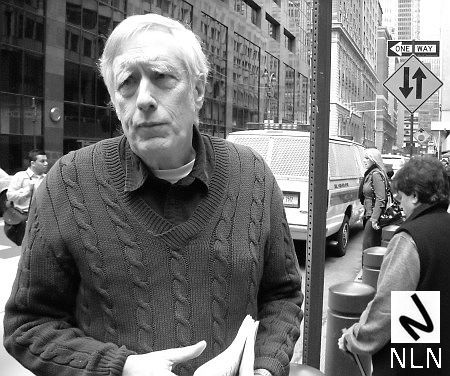
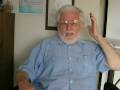
Henry Chalfant
(Photo: Bud Korotzer / NLN)
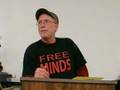
Documentary filmmaker Henry Chalfant read a statement from his wife, actor Kathleen Chalfant. She wrote that the plea-bargain brought an end to the agony of uncertainty for Fahad and his family and it makes it clear that, “Fahad is not and was not some grave moral threat to the country and its freedoms and principles. The grave moral threat to the country and its freedoms and principles lays somewhere else in this case. It lay in the idea that torture, and the conditions under which Fahad was held were traditionally sanctioned torture, that torture is justified in the pursuit of security. That notion will destroy this nation and its hopes more effectively than any bomb could. The strength of this country resides in its free institutions and not in adapting the policies of those we are fighting. I am very proud to have been asked to be part of this remarkable vigil. This is an example of what the best of America is. Standing in front of the Metropolitan Correctional Center, defending the constitution, and standing in support of and solidarity with people who have been denied it’s rights and protection.”

Suzanne Kelly
(Photo: Bud Korotzer / NLN)
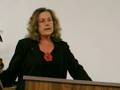
Then Suzanne Kelly read a statement from Wallace Shawn and Deborah Eisenberg: “It is obviously not irrational for Americans to be afraid of terrorist attacks or to try to prevent them. But if you don’t arrive at a rational approach to prevent these attacks we will find ourselves falling to the lowest level of a police state with the speed of an elevator whose cables have snapped. At the start and at the finish of the Hashmi case tricks of the theater have been used to make a human being look terrifying to an audience by the extreme conditions by which he was restrained. He was made to look like a dangerous animal, so ferocious that only the tightest and thickest chains could keep him from eating us alive. By the methods of isolation that kept him from communication with the outside world, his words were made to seem so poisonous, so hateful and terrible, that if they could be heard they would knock down walls and devastate cities. It could appear that he belonged to a movement so vast and so mighty that it had more power than the greatest criminal gangs to strike down it’s enemies wherever they might hide. In the face of these frenzied theatrical devices that not only presumed the guilt of the defendant but screamed it out across the public square, it is hardly surprising that the defendant has lost faith that our system of justice is really based on the presumption of innocence. Faced, therefore, with trying to prove a negative, that he is not a terrorist, to the satisfaction of a terrorized jury, he has decided to withdraw his claim of innocence. Meanwhile, down the street the criminals of high finance who have undoubtedly caused the suffering and even death of countless human beings go unpunished and instead are rewarded with prizes of untold wealth.”

Jeanne Theoharis
(Photo: Bud Korotzer / NLN)
Professor Jeanne Theoharis, Fahad’s former teacher, answered questions asked by people in the group. Someone asked if the “Special Administrative Measures” would be lifted now. Fahad is still being held under the SAMs. His lawyers asked for expedited sentencing and he will be sentenced on June 7. They are hoping he will be sent to a CMU (Communication Management Unit). As bad as they are — CCR has filed a suit against them and Amnesty International has condemned them — they are better than the conditions he is living under at the MCC. Judge Preska will recommend where he will be sent but she does not have the final say. Another question, what is next for those who want to pursue the human rights and civil liberties issues raised in this case? People will be meeting to decide what to do next. Issues of how people are treated in the federal system, which has been polluted by the thinking that created Guantanamo, have to be dealt with. Also, keep sending messages to Attorney General Holder expressing concern about the conditions of Fahad’s confinement. Another questioner wanted to know if Prof. Theoharis thought the activism, for example, the vigils, letters, magazine and web articles, statements by academics, journalists, and lawyers made any difference in the outcome of this case? Theoharis pointed out that the plea offer came a day after the government was granted an anonymous jury. That is not unconnected to his supporters being in the street for 6 months shining a light on the practices in this case. The brief asking for an anonymous jury is about public and media attention and there was no media attention until we began standing out here. We have to understand the landscape and that means understanding the civil rights issues and how the government comes to it’s decisions.

Anwar Hashmi (Fahad’s father) and attorney Sean Maher
(Photo: Bud Korotzer / NLN)
Sean Maher, Fahad’s attorney, spoke next. He began by profusely thanking the people at the vigil.
“We are here a week after someone plead guilty for material support for Al Qaeda and we have people here that understand that this is a world of a lot of gray, that things are not black and white, and that when injustice occurs it is our responsibility to stand up and talk against it. That is what you have done and you have made a difference. Show me another case, another terrorism case, that has been prosecuted in this country in the last eight years where after a conviction, after days have passed, people have come out on to a sidewalk to say, ‘You know what, there are problems going on in this country and we want people to see that we know that there are problems.'”
He added that nobody should leave here without knowing that their presence was important and mattered — the guilty plea doesn’t change that.
Maher explained that the legal defense team consistently raised three issues which have nothing to do with Fahad’s eventual plea:
1) Conditions of confinement — In a democracy where people are presumed innocent and should have due process, and they have community ties and no history of violence, they should not be caged worse than animals in a zoo. This is a political more than a legal issue.
2) Secrecy in the courts — Fahad’s lawyers challenged the Classified Information Procedures Act, they challenged lawyers having to be screened before they can get information about the case and then not being able to discuss the information with their clients. This is not a Military Commission at Guantanamo - this is a federal court. He made the point that he was speaking broadly, not about this case in particular.
3) People should not be prosecuted for terrorism based on religious of political ideology.
At trial the jury would have heard all about Fahad’s political and religious associations and the prosecution would argue that this goes to motive and intent to commit acts of terror.
The defense lost all the motions.
Maher said that Fahad made a decision that most likely saved him many, many years in prison. It was not an easy decision. The conviction rates in federal courts is 90 percent - higher in terrorism cases.
Faisal Hashmi, Fahad’s brother, then spoke. He thanked everyone and pointed out that his brother’s case was not the only one, there were many in the Muslim community. He said, “This case offered an opportunity for all of you to bear witness to what is going on. We struggle and advocate for our community and now we have more allies.”
Brian called Faisal a voice for justice and thanked him and his family for generously welcoming us into their struggle. As daisies were being handed out to the “vigil-antes” they were urged to cross the street carefully, looking both ways, and respectfully yet defiantly lay a flower at the foot of the prison. As people reached the other side of the street where the MCC stands, several federal officers suddenly appeared. One was shouting “Federal property! You can’t come here! Federal property!” As people dropped the daisies on the curb he kicked them and stomped on them. People were shocked by the vehemence and palpable hatred he exhibited toward them. Then, also suddenly, the NYPD was on the scene. By comparison they were very quiet and gently urged everyone to cross over to the side of the street that they had come from, which everyone did.
As people reached the other side and looked back they saw the federal officers standing near the opposite curb watching the vigil folks and guarding the perimeter.
View Photos From The Vigil…