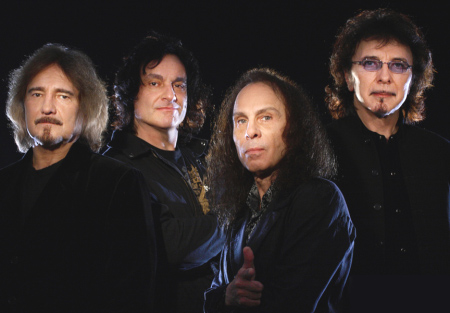
Heaven & Hell: Geezer Butler, Vinny Appice, Ronnie James Dio and Tony Iommi
(Photo: Mark Weiss / heavenandhelllive.com)
Every thirty years I see Black Sabbath live.
Last night the band wasn’t called Black Sabbath but as the DJ who introduced them said, whatever it’s called — it is Black Sabbath. And “Heaven and Hell” was indeed worthy of the name. I saw the original Sabbath in 1978 and they were excellent — but Heaven and Hell does not suffer by comparison to Black Sabbath in its heyday.
The venue was the WaMu Theater at Madison Square Garden. I had mistakenly assumed that my son and I would be seeing Sabbath in the same venue where the Rangers play hockey. Fortunately I was wrong - the WaMu is much smaller, with infinitely better acoustics. The seats are comfortable and the view of the stage is good from almost any vantage point.
The show began promptly at 7 p.m. — the opening act was the prog rock band Coheed and Cambria — and was over by 9:45. This is not unusual but nonetheless always strikes me as odd. When I was my son’s age — he wearies of hearing this — shows never started on time, never ended before midnight at the earliest, were deafening and the venue was always a fog of pot smoke. Times have changed, but luckily, there are some constants.
On November 5, 1978 I saw Black Sabbath live at the Hollywood (Florida) Sportatorium. Van Halen was the opening act and it was a striking contrast: David Lee Roth leaping about while Ozzy could barely stagger to the microphone stand. For Sabbath, this was the ironically titled “Never Say Die” tour - the last tour that included Ozzy Osbourne. Ozzy and Sabbath were wonderful. Stoned, drunk, whatever else - Ozzy and company played most of the Paranoid album and a variety of hits from their other recordings. It was a memorable show.
For many years following this show, I didn’t listen to new Black Sabbath recordings as I couldn’t envision the band without Ozzy. And for years Black Sabbath founder Tony Iommi and newcomer Ronnie James Dio, guitar and vocals respectively, struggled with one another. The result was a fractured catalogue of recordings: the well regarded releases “Heaven and Hell” (1980) and “Mob Rules” (1981) — followed by five Sabbath albums without Dio — and then the final Dio-Iommi effort as Black Sabbath: “Dehumanizer” (1992). After only three albums it appeared the so-called “Heaven and Hell lineup” — Tony Iommi, Geezer Butler, Ronnie James Dio and Vinny Appice — was a part of rock history.
Fast forward 15 years…
In April of 2007, Rhino Records released a compilation called Black Sabbath: The Dio Years. The CD featured three new songs recorded by the Heaven and Hell lineup. Pleased with their new material, Iommi and Dio, et al. decided to reunite. As Black Sabbath’s original lineup had also reunited (in 1997), Dio and Iommi opted to call their project “Heaven and Hell”, after the first album they created together — and the title track that has become a Sabbath anthem. The resulting tour produced a CD and DVD entitled “Live from Radio City Music Hall”. This in turn spawned an album of all new material called “The Devil You Know”, released in April of 2009. It was “The Devil You Know” that caught my attention — I bought the disk just to see what Iommi was doing these days and came away very impressed. This ranks as one of the finest Sabbath recordings ever — by any of the lineups.
And so, not surprisingly, the show at the WaMu was very good. The band was in top form and the setlist included three tracks from “The Devil You Know”: “Bible Black”, arguably the best track on the disk (this tour is called the “Bible Black” tour), “Fear” and “Follow The Tears”. The remainder of the songs were pulled from the “Dio Years” body of work and included “Mob Rules”, “I”, “Children Of The Sea”, “Falling Off The Edge Of The World”, “Die Young”, “Heaven and Hell” and the encore, “Neon Knights”.
Iommi, clad in a black leather coat and playing his familiar Gibson SG, was inspired. As was the 67-year-old Dio, small in physical stature but endowed with a truly operatic vocal ability. Geezer Butler was equally impressive on bass and Vinny Appice’s drumming was excellent. Generally I find drum solos rather generic and a good time to check e-mail but Appice’s solo was entertaining and flew by.
Stage props included transparent globe streetlights, a cemetary fence encasing the amplifiers that flanked Appice’s drum riser and a rather elaborate drum kit. Appice had a variety of drums suspended high above the usual array of snare, bass and floor toms. He utilized these drums, which resembled pots and pans hanging above a kitchen stove, infrequently — primarily in his solo. Geezer, also clad in black and playing a Lakland bass, stood stage right (house left). Iommi stood opposite Geezer — as a southpaw the headstock of his guitar pointed towards Appice and Butler, who returned the favor. This minor detail reveals how precise everything about the show was. The music was delivered with obvious attention to detail as well — the diminutive Dio introduced all of the songs, belted out some incredible vocals and thanked the audience profusely. Several of the songs were illustrated by animated video clips that were displayed on a screen above Appice’s drum kit.
Dio mentioned several times during the performance that there were gaps between the recordings by this incarnation of Sabbath due to a lot of “water under the bridge”. He thanked the audience for supporting the band “All of these years, particularly the last three”. You got the feeling that Ronnie had real regrets about the turbulent history of the Heaven and Hell lineup. And that he genuinely appreciated the opportunity to make up for lost time. At one point Dio told the crowd, “Life still sucks but you have us and we have you and together we have the music.”
Introducing Tony Iommi’s guitar solo by referring to Tony as “the greatest guitar player who ever walked the Earth”, Dio walked offstage. Iommi gently patted the back of Dio’s head as he walked by — a gesture that seemed quite genuine and indicated that the Heaven and Hell bandmates have left their troubles in the past and are enjoying themselves as they make some great music.
I bought my first Sabbath album, Master of Reality, at a Maumee, Ohio K-Mart in 1971. I was 14 at the time. And so, when the show ended last night, I asked my 14-year-old son what he thought of Heaven and Hell.
“They were good,” he said.
I’d have to agree.