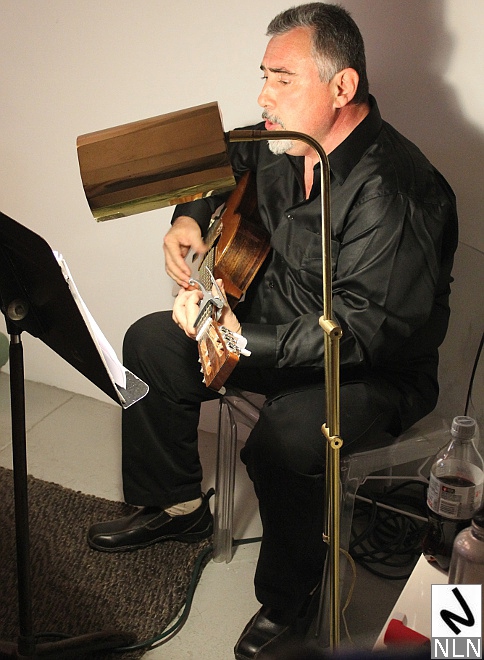
A guitarist plies his trade in Zuccotti Park
(Photo: Thomas Good / NLN)
“Sunday Morning” is probably my favorite Lou Reed song — I play it, you guessed it, every Sunday morning. I suppose it’s a combination of the lush production and the starkly beautiful voice of Nico (she sings the harmony) that does it for me. I’ve always admired Nico and had the good fortune to see her perform in the Lower East Side in the early Eighties.

Relaxing with some music on a Sunday
(Photo: Thomas Good / NLN)
“Sunday Morning” was written quickly, in an effort to produce a hit. There’s a lot to be said for fast takes and songs written straight from the heart.
“Sunday morning, praise the dawning — It’s just a restless feeling, by my side…”

Drummers can be found along Church Street — dancers too
(Photo: Thomas Good / NLN)
***
World War One, the so-called Great War, was not only an exercise in futility but a good example of the all-too-human capacity for brutality. It was the first war where the machine gun was widely used — with predictable results.
In the first year of the war, after peppering one another with a hail of bullets for four months, German and British troops observed a Christmas truce. Soldiers crossed no-man’s land and visited their opposite numbers, bringing gifts and staying for dinner. Many of the Germans who broke bread with the British in the Ypres sector were Bavarian. One of their number, a corporal named Adolf Hitler, thought the truce was terrible — as did the generals on both sides.
The Christmas Truce stands as a bright spot in a four year stretch of carnage and destruction that destroyed an entire generation.
***

On Sundays it is usually possible to talk with protesters
(Photo: Thomas Good / NLN)
On Saturdays the Occupy Wall Street protesters march. The police follow. And too often the police treat the protesters as if they were the enemy - battering, bruising, and arresting the unarmed and unresisting. It’s tough to guess why the policing has been so aggressive. Perhaps the goal is to provoke the protesters for political purposes. To their credit the protesters have demonstrated a degree of professionalism that so far has largely eluded the police department.

Reading the Journal — The Occupied Wall Street Journal
(Photo: Thomas Good / NLN)
On Sundays the police presence at Zuccotti Park is muted. There is little of the aggressive behavior usually visited on the plaza by police at other times: officers telling pedestrians they have to keep moving, as if the public sidewalks and streets belong to someone other than the people. As if talking to the protesters is something to be avoided.

There are a lot of students in the park on Sunday
(Photo: Thomas Good / NLN)
On Sundays the protesters seem to want to recharge batteries and the atmosphere is calm, soothing, family friendly.
***
I enjoy black-and-white film photography and shoot as many frames as time allows - developing the film at home and printing in a public darkroom.

Every photog and journo I’ve spoken with described the protesters as “welcoming”
(Photo: Thomas Good / NLN)
Although I often carry my battered Nikon film cameras with me, I use digital SLRs and shoot color — usually in burst mode — when doing photojournalism. Doing “PJ”, as photogs call it, does not always allow for art. It is possible to craft an interesting shot, it is possible to get a sharp image, but the goal is to “get the shot” and all other considerations are secondary.

On Sunday cops and journos have some downtime
(Photo: Thomas Good / NLN)
And so I shoot digital as I have to — but I prefer film.
Film forces artistry and craft to the foreground. Especially black-and-white film. With monochrome images composition and contrast are key and film can be unforgiving. For those of us who love nothing more than watching a print develop, it’s a labor of love. And when I can’t shoot film but find an opportunity to do something arty, I set my digital cameras to emulate Kodak Tri-X film: I set the ISO (speed or light sensitivity) to 400, and set the “color” to monochrome. Often I use both types of cameras — film and monochromatic digital — in one shoot. The digital camera can be used to set up shots in tricky lighting.

An activist does a bit of stenciling for someone visiting the encampment
(Photo: Thomas Good / NLN)
Zuccotti Park is a tough shoot. It’s very dark in the interior and very bright and glary on the periphery. I like to shoot there on Sundays when there is no pressure to “get the shot.” It’s nice to have time to talk with people, hear their stories, and try to do a portrait or two. As I told one woman, Sunday is about the people. Even the police seem to understand that Sunday is a good time to observe a truce. Maybe one day that truce will be formalized into an armistice and the false binary that is the Police Department vs. Participatory Democracy will be ended.
There’s always hope. Especially on Sunday Morning.
Praise the dawning.

(Photo: Thomas Good / NLN)
Click HERE to see more Sunday Morning shots

Labor in the house
(Photo: Thomas Good / NLN)