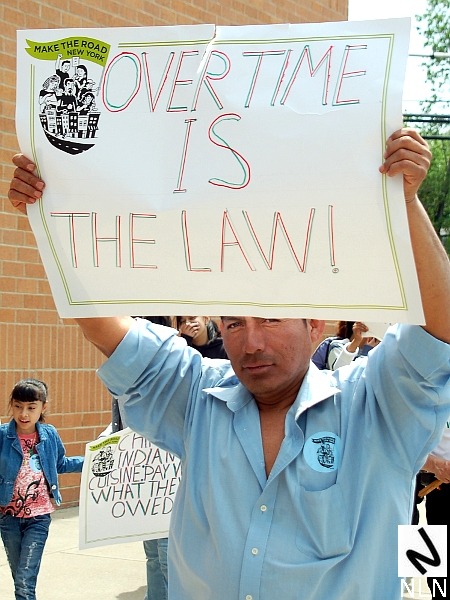
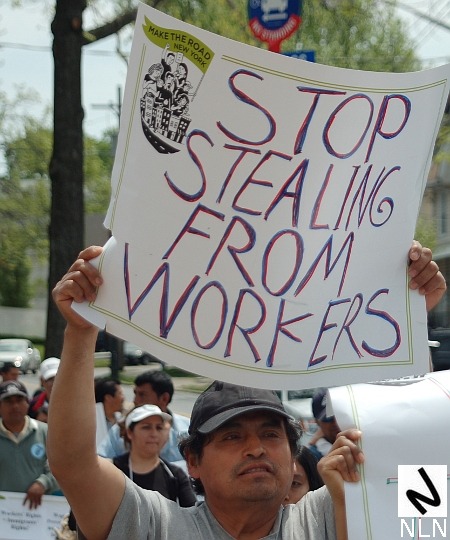
Is housing a human right in the United States? Not yet, according to a variety of housing activists.
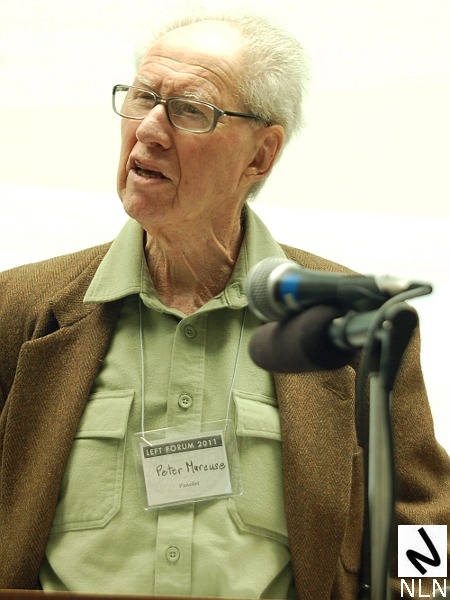
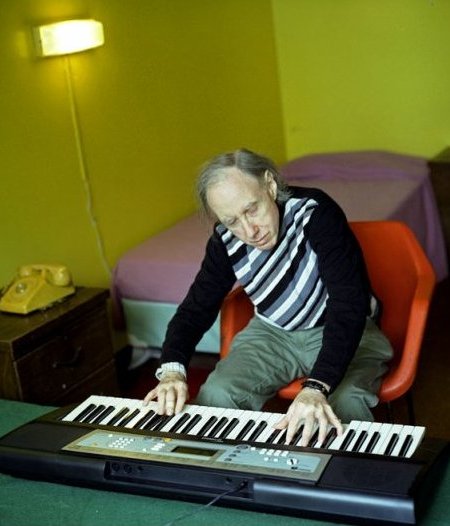
Urban planner Peter Marcuse believes housing is a human right
(Photo: Thomas Good / NLN)
HOUSING IS A HUMAN RIGHT
* Except where prohibited by law.
The poor, the aged, the homeless, the mentally ill — the “huddled masses” who yearn for a place to call their own — are our friends, neighbors, relatives and fellow citizens. And they are all struggling with life during wartime. In the 21st Century the United States has witnessed a sub-prime mortgage scandal that made paupers of those who would be homeowners, bailouts and bonuses for the bankers who brought us the crisis, tax cuts for the needy rich, a national debt that today’s toddlers will inherit when they enter what’s left of the work force, and a poverty draft for the poor who have been stop lossed into fighting two interminable wars, returning home where their traumatic brain injuries and post traumatic stress disorders are treated with substandard health care. And at the helm we have a president who argues that the assassination of one terrorist demonstrates that “America can do whatever we set our mind to.” Indeed, if what we set our mind to includes not caring for the have-nots, torturing prisoners, attacking sovereign states without a declaration of war and violating the civil rights of citizens in the name of democracy — in short, violating human rights in almost every aspect of domestic and foreign policy.
Social critics and muckraking journalists have a wealth of failures to choose from when looking to write a story about modern America. But the issue of housing stands out. What could be more fundamental than food and shelter?
THE PROGRESSIVE HOUSING PANEL
At the 2011 Left Forum, held at Pace University in lower Manhattan, distinguised professor and urban planner Peter Marcuse (son of philosopher Herbert Marcuse) moderated a panel that featured housing activists who approach the issue in a variety of ways. Common themes included the acute shortage of affordable housing, government and landlord attempts to privatize public housing, homelessness, and the increasing divide between haves and have-nots.
Madison, Wisconsin’s Monica Adams described Take Back the Land‘s efforts to occupy housing that is vacant as a result of foreclosure. Although attempts at “gaining community control of land through direct action” has provided some families with housing, there are several factors to be considered before occupying a dwelling. The comfort and safety of the family, most often African-American, in a home that is situated in a white neighborhood, is a paramount concern. So while this approach is viable for some it does not provide an overall solution.

Michael Kane is an organizer with NAHT
(Photo: Thomas Good / NLN)
Michael Kane, based in Boston, is an organizer with the National Alliance of HUD Tenants (NAHT), a group that uses a trade union organizational model for housing advocacy — local members fight to save local buildings and also send delegates to D.C. where lobbying takes place. NAHT represents tenants of private housing that’s subsidized by HUD. The property owners are too often looking to eliminate the subsidy and charge market rates — NAHT works to prevent this. In addition, the union fights for and against bills that are before Congress. Each legislative victory becomes what Kane calls “a handle” that the union can use at the local level - a ruling that may block a landlord from being able to convert a HUD subsidized property to market rate.
Kane said, “In Boston, we added it up, we’ve saved 11,400 apartments, one building at a time, through tenant organizing strategies, over 27 years.”

Tenant Association president Eric Crawford
(Photo: Thomas Good / NLN)
Eric Crawford, an NYC Tenants Association President, and Mo George of Community Voices Heard (CVH), spoke about the struggle to get public housing officials to make needed repairs in a timely manner. George said that requests submitted today will receive appointments for 2013 or 2014 due to a three year backlog. Also frustrated with lacking repairs, Crawford described how he deposits himself in the office of a housing official and declines to leave until his complaints are heard. Both organizers said that the effort involved in procuring essential repairs is exhausting and the NYC Housing Authority is expert at evading its responsibilities. In terms of a long range solution, George said that CVH is promoting an initiative called “participatory budgeting” — an effort that would give community members a voice in setting budget priorities for public housing agencies.
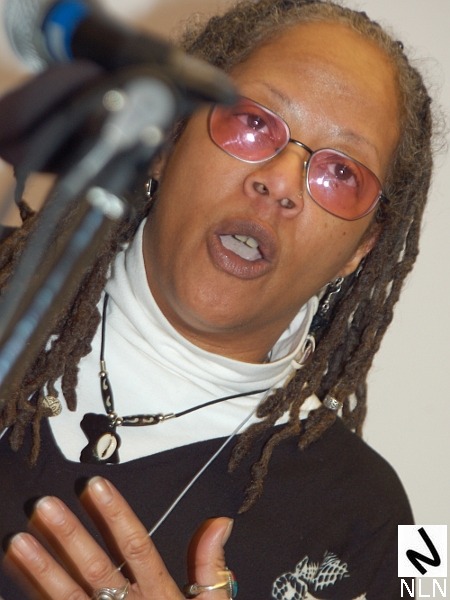
Kendall Jackman of Picture The Homeless
(Photo: Thomas Good / NLN)
Kendall Jackman of Picture The Homeless described how her organization uses outreach as its primary means of raising awareness. Despite the obstacles presented by homelessness, PTH members are able to advocate for affordable housing in the internet age — PTH computers make electronic outreach possible. Like their counterparts in Take Back The Land, PTH members are pushing Bloomberg to make good use of vacant apartments rather than giving these properties to developers. The census of vacant properties is something PTH would like to see done on an annual basis and they are lobbying the City Council to make this happen.
Eric Crawford said that the daunting tasks facing housing activists show the need for a mass movement. “I believe we need to come up with something similar to concept of the Tea Party movement, not saying that I endorse them, but we need a crazy type of movement in public housing,” he said.
Although organizers differed on approaches and how much a group should compromise or negotiate with officials, all of the organizers agreed that sweeping change is needed and that, approaching coalitions on an issue-by-issue basis, especially in the face of impending budget cuts in Washington, unity is essential.
DON’T PETRA-NIZE ME
One strand uniting the activists who took part in the Forum’s housing panel was concern about PETRA.
PETRA is the Preservation, Enhancement, and Transformation of Rental Assistance Act of 2010, a HUD proposal that would allow Public Housing Agencies (PHA) to mortgage existing properties that are subsidized by HUD. The PHAs would solicit monies from private investors in order to maintain the properties, many of which are currently deteriorating. Activists are concerned that, in the event of foreclosure, the property might disappear from the pool of subsidized housing. Housing activists have been vocal in expressing their concerns — prompting HUD Secretary Shaun Donovan to offer reassurances. In order to address the concerns of the activists, Rep. Keith Ellison (D-Minnesota) drafted a document that revises the original PETRA proposal. Ellison submitted the Rental Housing Revitalization Act, or H.R. 6864, to the Financial Services Committee in 2010 but it never got out of committee. Ellison is expected to resubmit the bill to the 112th Congress, in 2011. Activists will be watching this bill closely.
***
|
NLN Video Coverage of the Left Forum |






***
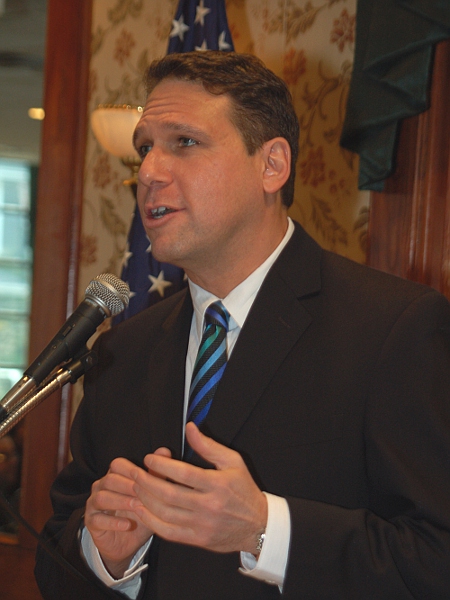
Staten Island Mental Health Council co-chair Larry Hochwald
(Photo: Thomas Good / NLN)
HOUSING, MENTAL ILLNESS — AND THE MEDIA
In February of 2011, the Staten Island Advance ran an editorial attacking a proposed supported housing program designed to house, in small apartments, 59 mentally ill people.
The Staten Island Advance’s editorial staff found it “stunning” that “that Saint Vincent (sic), under an agreement with the state, planned to turn [ a former convent ] into a residence for 59 mentally ill people.”
The editorial went on the describe some of the potential occupants of the facility as “Individuals discharged from prisons and jails, including sex offenders, acute psychiatric patients as well as drug addicts.”
Citing some anti-discrimination boilerplate in the Office of Mental Health (OMH) request for proposals, and ignoring the former St. Vincent’s (now St. Joseph’s) repeated assurances that a rigorous screening would ensure that only appropriate, stable clients would be accepted, the Advance went on to cite an unspecified court ruling (the Disability Associates Inc. v. Paterson “adult home” ruling) as evidence that a 59-bed facility was no longer viable.
“The courts have eliminated that large-scale residence option,” the Advance intoned.
The misreading of the ruling — a decision that affected several for-profit adult homes that house over 200 people each and provide no clinical services — was particularly ironic given that the court ordered remedy required OMH to move clients from adult homes INTO supported housing facilities, such as the one the Advance opined against. The letters to the editor from several very vocal neighbors and opponents of the proposed facility - the standard NIMBY response - doubtless played a role in the Advance’s conflating of adult homes and supported housing.
A similar, apparently self-serving, logical error was offered up at a public hearing in 2009 — an attorney who resides near the proposed facility argued that placing clients in individual supported housing apartments, clustered in one housing complex and supervised by clinical staff, subjects the residents to “stigma.”
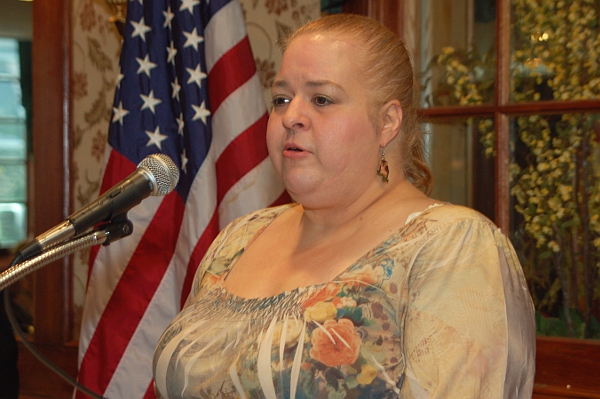
Mental Health Council co-chair Angela Hebner speaking about the need for peer support
(Photo: Thomas Good / NLN)
The supported housing model provides for peer support and most often the stigma residents encounter emanates from anxious neighbors who have been told by civic groups and local media that the mentally ill are “sex offenders, acute psychiatric patients” and “drug addicts.” One wonders if the Staten Island Advance is aware that the individuals so characterized read the papers — and are offended, if not wounded, in the process.
One individual who read the editorial and was both wounded and offended was activist Larry Hochwald, co-chair of the Staten Island Mental Health Council, an advocacy group.
Speaking at a legislative breakfast on March 18, Hochwald commented on the Advance finding it “stunning” that a supported housing project would house 59 mentally ill people.
“They seem to be very fearful of 59 mentally ill people being in one room together — that may explain why they didn’t answer our invitation today,” Hochwald said.
Hochwald spoke about mistaken notion that the concept of a supported housing facility “has passed.”
“How they decided that this [ the adult home ruling ] included supported housing buildings is very interesting and it speaks to what is great about America. It speaks to what I love about America, which is freedom. You have the freedom to do just about anything. You can run a newspaper and never do any research or fact checking,” Hochwald said.
Hochwald said that preparation for community integration is a goal of supported housing residents — residents who reside in buildings that “blend into the community.” Hochwald said that this goal is not addressed by adult homes who provide custodial — rather than clinical — care.

Peter Leone describing how the Skylight Center day program changed his life
(Photo: Thomas Good / NLN)
***
|
NLN Video Coverage of the Legislative Breakfast
|

***
MUCKRAKERS AND STALLED LITIGATION
In 2002 the New York Times ran a series of stories called Broken Homes that detailed how the mentally ill were being warehoused in adult homes — a strategy that saved New York state money but produced what the Times described as “Neglect, malfeasance and death.”
A resident of Surf Manor (Brooklyn) lives in spartan surroundings
(Photo: Erica McDonald)
A Brooklyn based photographer named Erica McDonald also documented the treatment of the mentally ill — spending two years photographing Surf Manor residents. She published her work in Mother Jones in 2010.
In 2003 an advocacy group acted to end the suffering, ultimately winning a protracted, David and Goliath, struggle.
A landmark court case, Disability Advocates Incorporated v. [ Governor David ] Paterson, resulted in a decision commonly known as the “adult home ruling.” The 2009 ruling by a federal judge (Brooklyn district) determined that New York State had violated the Americans With Disabilities Act by placing mentally ill patients in nursing homes. The ruling required the Office of Mental Health to create 4500 new supported housing beds over three years as a remedy (creating 1500 beds per year). Patients residing in nursing homes would then have the option to move into supported housing facilities. OMH complied by issuing a Request for Proposals (RFP) and awarding beds to established supported housing providers. However, due to budgetary constraints, OMH reassigned beds that had been previously promised to providers looking to expand housing opportunities for patients currently on hospital units or living in shelters — in effect borrowing from Peter to pay Paul. Hochwald and other housing advocates want these beds back. Hochwald argues that while adult homes are far from ideal the clients there have a roof over their heads — while many New Yorkers do not. The situation remains unresolved as OMH has opted to appeal the ruling — an appeal that will probably only delay the inevitable, at taxpayers’ expense. Housing advocates agree that there is a severe shortage of appropriate housing for the mentally ill and that moving OMH funded beds from one proposal to another, to satisfy a court order, is not a solution.
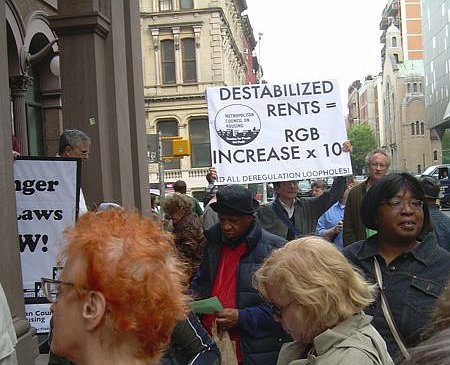
The MET Council protest at the Rent Guidelines Board meeting
(Photo: Metropolitan Council on Housing)
HOUSING AND CIVIL DISOBEDIENCE
Several of the housing activists at the Left Forum panel on Progressive Housing said that members of their organizations had participated in civil disobedience actions as a means of focusing attention on the shortage of affordable, appropriate, housing.
In New York City, the Metropolitan Council on Housing — a tenants’ rights organization formed in 1958 — has also used civil disobedience to make their case.
In recent years the Met Council has disrupted Rent Guidelines Board (RGB) hearings — hearings that approve rent hikes — and been hauled away in police vans. The Council works to preserve rent stabilized and controlled apartments in New York City and to fight the “vacancy destabilization” of apartments — under a 1997 law an apartment with a rent of $2000 a month or more that becomes vacant can be certified “decontrolled,” allowing the landlord to convert to market rate. According to the Met Council, 300,000 affordable apartments have been lost to vacancy destabilization since the late 90s. The Council is currently campaigning to get Governor Andrew Cuomo to renew rent regulations, set to expire on June 15. Should the regulations expire, the West Side Neighborhood Alliance has argued that, “Two million people will likely see their rents skyrocket, and will no longer have basic rights (such as a right to a lease renewal and protection against arbitrary eviction).”
On May 3 the Rent Guidelines Board held a preliminary vote on maximum rent increases for over two million rent-stabilized tenants. During the vote a number of MET activists were arrested — at a protest highlighting the rapidly-growing population of New Yorkers who have no rent protections.
HOUSING IS A HUMAN RIGHT
* Except where prohibited by law.
In an advanced industrial society that touts itself as the most prosperous nation in the history of humankind it would seem a given that all of its people would be able to go home, to be housed appropriately, rather than having to sleep on the streets, in a shelter, in a nursing home, on an inpatient unit, in sub-standard housing — or in a jail cell. It would seem a given that housing would be acknowledged as a basic human right.
But we are not there yet.
***