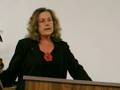
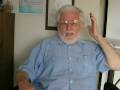
Carl Oglesby at Brown University in 2006
(Photo: Thomas Good / NLN)
Carl Oglesby, one of the most eloquent leaders in the movement against the war in Vietnam, died of cancer on September 13. He was 76.
As a Students for a Democratic Society member in Oklahoma, I first heard of him in early 1965 through a long mimeographed article about the war that he wrote that was sent out to chapter leaders. Along with Robert Scheer’s pamphlet, How the U.S. Got Involved in Vietnam, it convinced civil rights and anti-poverty activists that they had to take action against the war. Its prose sizzled with persuasiveness and urgency.
My first physical view of him was at that year’s SDS convention. I was curious to see the man behind the article and he was every bit as impressive in person as he had been on paper. He was tall, thin, and bearded with the intensiveness of an engage scholar — more than a little like the character played by Marcello Mastroianni in The Organizer.
SDS was running on a high. Two months earlier it had organized the first march on Washington against the war, the success of which had exceeded everyone’s expectations and the organization was in the national spotlight. At the march, SDS President Paul Potter had delivered a searing indictment of the war that went straight to the moral and historical responsibility to stop it.
For reasons that I don’t know, the organization was locked into changing presidents every year. Al Haber, Tom Hayden, and Todd Gitlin had been the first three before Potter. Now the organization would have to choose another president who would instantly become the focus of intense national and international scrutiny. It was a key decision for the 200 or so people at the convention.
Potter and the previous presidents had all been long time members active in national meetings. Oglesby was not. He had been living in Ann Arbor while working for a defense contractor, a job he had taken after not being able to earn enough as a writer. He had a wife and three children, a suburban house, and was a good ten years older than the average late teen, early twenties SDS member. As the U.S. was beginning to escalate the war, he became increasing aghast and joined forces with SDS members at the University of Michigan.
There were a number of strong candidates for President, but the convention was smitten with Oglesby and a few months after joining the organization he was its new president.
A month after the convention I went to work in the national office in Chicago. Oglesby came through on his way to Japan, where he had been invited to represent the U.S. antiwar movement. On his way back we learned that he had caused a near scandal by challenging well known Japanese intellectuals on television to take a position on the war. The Japanese press buzzed with coverage of this audacious American.
That November there was a second, even larger, march on Washington, and he was the star speaker. He began: “Seven months ago at the April March on Washington, Paul Potter, then President of Students for a Democratic Society, stood in approximately this spot and said that we must name the system that creates and sustains the war in Vietnam?name it, describe it, analyze it, understand it, and change it.”
Oglesby went on to identify the system as corporate liberalism, showing how obedience to corporate interests, domestic liberalism, and imperialist aggression could all be wrapped up into one unitary dominant politics. He exposed cold war liberals for what they were and set SDS to their left.
It was a speech the articulated and oriented the sentiments of the movement.
The response was overwhelming. News organizations identified SDS as the epicenter of the movement against the war and flooded the national office with interview requests. Each day’s mail brought scores of letters from students inquiring about how to organize new chapters. There was excitement in the air.
Oglesby toured campuses and spoke widely elsewhere in and out of the country, on his way to becoming an international celebrity, a status he would occupy for the rest of the 1960s.
In Chicago at the 1968 Democratic Party Convention demonstrations, I remember him speaking to a large crowd as the police began moving in and clubbing. As I was running to escape, I heard his surreal indignant words over the loudspeaker, “Are you surprised?”
What those of us who were ten years younger were not sensitive to at the time was that it was not so easy to suddenly assume the role of full time activist when you already had a family that included three children, to move from a middle class income and stability to a hand to mouth economic existence. He had made an existential decision to give his life to the movement come what may and it took a toll that eventually led to the family breakup.
He was also became involved in wrenching disputes with the Weather faction and feminists.
By the 1970s as the crowds were waning and the movement was losing steam and breaking up, Oglesby became like everyone else, a veteran. Five or six years earlier we had all believed that the movement would keep growing until the whole society was transformed and then we would be involved in its reconstruction. But that was not to be.
People adapted in different ways. The Weather people went underground. Some went into Marxist-Leninist party-building as a kind of organizational tightening to compensate for the increasing loss of public resonance. Some went into the Democratic Party and tried to move it to the left. Others got involved later in solidarity for third world revolutionary organizations. Still others went into what later become known as identity politics. Many dropped out of activism altogether. A very few went to the right.
Oglesby struck out on an eclectic path. He recorded two music albums. He delved into conspiracies around the Kennedy assassination. He invented and explored in writing the useful Yankee-Cowboy thesis as a way to analyze divisions in the American ruling class. He ended up flirting with right wing libertarians.
His trajectory was consistent with a kind of radical eclecticism that existed in some quarters of SDS — an umbrella organization that had contained disparate and sometimes contradictory tendencies. (It was in SDS that I met an ideological species that identified itself as anarcho-Maoist.)
I saw him in 1974 in San Francisco. A neighbor of mine, the creator of Young Lust comics (don’t ask), was having a wedding reception at the warehouse of The Fabulous Furry Freak Brothers — another underground comic. I spotted Oglesby and we chatted for a while. He was excited about libertarians he had met. He said that they had the same interests we had. I expressed my doubts and we let it go at that.
He struggled to remain relevant in a historical period marked by the end of the movement and the decades long ascendance of the new right. In retrospect, it can be said that he had already made his mark on a particular historical period that was intense but short.
But he made quite a mark. Bob Ross, a former SDS vice president, wrote, “Edward R. Murrow said of Winston Churchill in 1940: ‘Now the hour had come for him to mobilize the English language, and send it into battle, a spearhead of hope for Britain and the world. … It sustained. It lifted the hearts of an island of people when they stood alone.’ John F. Kennedy glossed this when, presenting Churchill with honorary citizenship he said: ‘He mobilized the English language and sent it into battle.’ Well, Carl Oglesby was our Churchill. In the year he was SDS President, and after that, Carl was our Tribune. With infinite eloquence he mobilized our forces against an unjust war. His passion in words led our passion in the streets.”
I will always remember Carl Oglesby for having shown those of us in the movement at our best by articulating most eloquently our highest ideals and intelligence. In his historical moment, he made you proud to be a part of the same common movement.
***
James W. Russell was the first editor of New Left Notes, the SDS national newspaper. His newest book, Escape from Texas, a historical novel about slavery and the Texas War of Independence, will be published later this year.
|
“The financial burden of the war obliges us to cut millions from an already pathetic War on Poverty budget. But in almost the same breath, Congress appropriates one hundred forty million dollars for the Lockheed and Boeing companies to compete with each other on the supersonic transport project-that Disneyland creation that will cost us all about two billion dollars before it’s done.”
“We are dealing now with a colossus that does not want to be changed. It will not change itself. It will not cooperate with those who want to change it. Those allies of ours in the Government - are they really our allies? If they are, then they don’t need advice, they need constituencies; they don’t need study groups, they need a movement. And it they are not, then all the more reason for building that movement with the most relentless conviction.”
— Carl Oglesby, November 27, 1965
Click Here to read”Let Us Shape The Future” by Carl Oglesby
|