Howard Zinn
(Photo: Wikipedia)
A Personal Note on Howard Zinn, by Paul Buhle
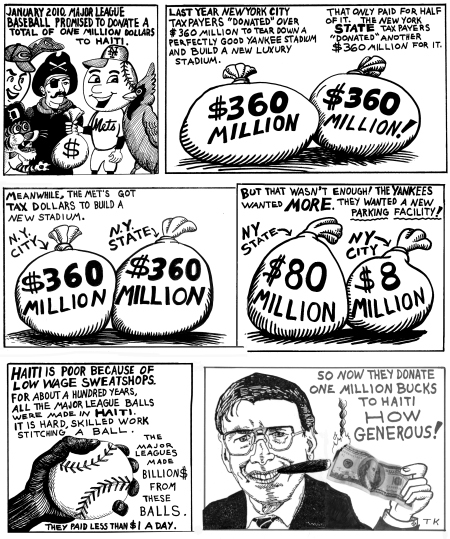
Whoever wants to know more about Howard Zinn’s life and accomplishments can find the details easily upon the web. I only want to add my own little bit, how I misunderstood and underestimated his popular histories for years, how I grew to admire him as I came to understand their importance, and how I was lucky enough to work with him on the comic art version of his story, A PEOPLE’S HISTORY OF AMERICAN EMPIRE.
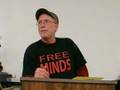
Howard was always a bit larger than life and perhaps for that reason a bit distant to the New Left historians coming of age in the later 1960s and early 1970s. He had a legendary life already, from the Depression to the Second World War to the civil rights movement to the antiwar movement. In Boston especially, but far beyond, he was a speaker everyone wanted to hear, in an era when really appealing white radical speakers were not all that numerous (and they had this in common, most of them: the burden of what could be called guilt but would be better understood as TAKING RESPONSIBILITY for the civilization that prided itself so much, but took little responsibility for its effects upon others, or even the unfortunate at home). There was always something about Howard: if a speaker like Noam Chomsky was best in the Q-and-A, answering point for point and elaborating, Howard had an aura, the proverbial pin could drop as an audience small or large listened for his words. Sometimes, like CLR James, he would start a little quiet as he built up his physical delivery. Then, look out: he overwhelmed with eloquence. It was easy to get a catch in the throat while listening to him.
But I kept my distance unintentionally, publishing a new left radical magazine, creating oral history projects among radical oldtimers, writing social history and so on. He once told me that he was surprised his PEOPLE’S HISTORY was so popular, it might not even have been his best book. But it went to the heart of the issues of US history, and proved to be exactly what young people and many not-so-young needed to understand. My generation was great at finding and elaborating details. Howard was better at explaining them, incredibly better.
So it was my not-so-brilliant idea, after the creation of WOBBLIES! (a comic about the history of the IWW, produced on the centenary), to create a book that encompassed his classic and, in a sense or two, went a bit beyond it. Why beyond? Because when it comes to Empire, the American Empire, William Appleman Williams was the master radical history of the 1950s-60s. He didn’t grasp race and he hardly grasped class, but Williams had Empire down cold. So his work became a supplement of sort, an amendment, to the guiding ideas in Zinn’s work.
I did one more thing that was useful: insisting that Zinn’s own life be part of the story. The children of impoverished immigrants with a brother dead from an ailment that middle class families might have had healed, the working class guy who took part in 1930s radical demonstrations, worked at a defense plant, went into the war, and got the upward mobility of the GI Bill, he had been through it all by the time he went South as a teacher in the 1950s. His life, this life, was embedded in everything he did. Being able to see it on paper a comic art—thanks to scriptwriter Dave Wagner and artist Mike Konopacki-was one of the great pleasures of my intellectual life. I KNEW that we had created something that would find an audience and set an example for what comic art can do to offer simple but necessary truths.
That was my Zinn Moment. Since then, Dave Wagner and I have pondered how to understand and explain Empire as being a bipartisan operation at the center of American political life. The disillusioning developments of the past twelve months offer more to consider, no matter that we learn what we did not want to learn. We know that Howard, to the very end, was delivering the essential message. We will be hearing him, in one form or another, so long as the quest for imperial power, imperial dominance of the planet, is the deep logic of our rulers. It is not a message about Evil Americans, but about those who assumed too much about their own mostly good fortune and those in power, and who now must come to understand the dilemma that we all face together as humans: empire or survival, empire or species self-realization.